What Are Lauryl Alcohol Ethoxylates?
Lauryl Alcohol Ethoxylates are nonionic surfactants produced by reacting lauryl alcohol with ethylene oxide under controlled conditions — a process called ethoxylation. The result is a versatile family of molecules used across cleaning products, textile auxiliaries, agrochemical formulations, and industrial processing aids.
Because they carry no ionic charge, LAEs are compatible with a wide range of actives and electrolytes, making them highly adaptable. Explore the full product range on our Lauryl Alcohol Ethoxylates product page.
Understanding Ethoxylation and Grade Selection
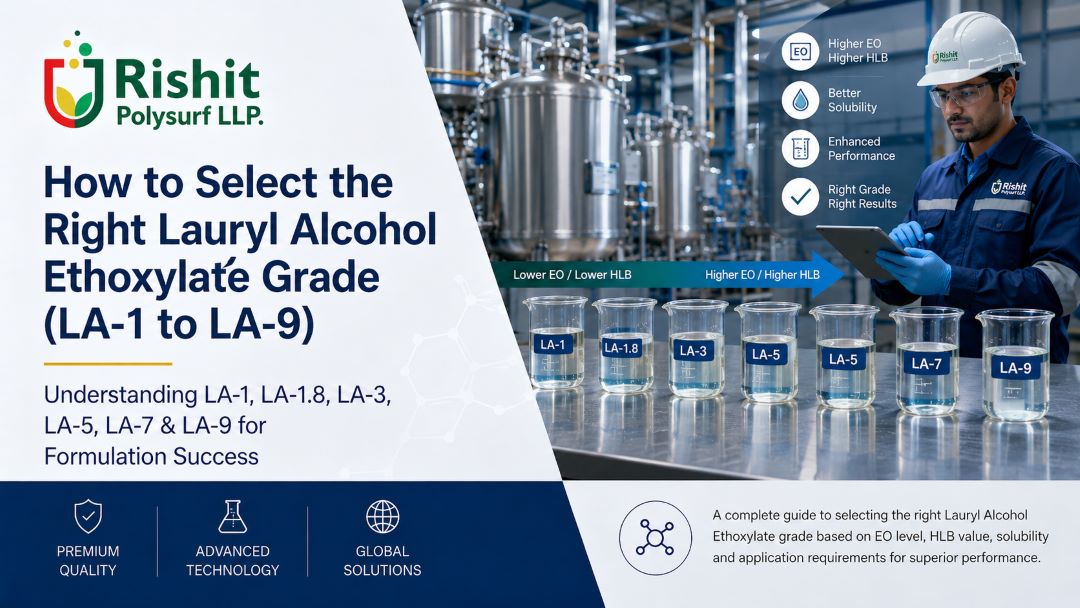
The number following "LA" in a grade designation indicates the average number of ethylene oxide moles added per molecule. As this number rises:
- HLB value increases — the molecule becomes more hydrophilic
- Water solubility increases — from oil-dispersible to fully water-soluble
- Emulsification profile shifts — from water-in-oil (W/O) toward oil-in-water (O/W) systems
This progression allows formulators to fine-tune surfactant performance simply by selecting the appropriate EO count.
Common Lauryl Alcohol Ethoxylate Grades
LA-1
With the lowest EO content, LA-1 has a low HLB value and limited water solubility. It is well suited for use as an intermediate in specialty chemical synthesis, low-HLB emulsifier blends, and formulations where minimal hydrophilicity is required.
LA-1.8
LA-1.8 sits at the lower end of the medium-HLB range. Its moderate solubility profile makes it useful in emulsifier systems and industrial formulations where a controlled balance between oil and water affinity is needed.
LA-3
With three moles of EO, LA-3 offers a moderate HLB and improved water compatibility. It finds regular use in industrial cleaners and textile auxiliaries, particularly where wetting and penetration into fibres or substrates is required.
LA-5
LA-5 moves into medium-to-high HLB territory, offering good water solubility and strong detergency. It is a workhorse grade for detergent formulations and general-purpose cleaning products.
LA-7 and LA-9
At the upper end of the range, LA-7 and LA-9 are highly water-soluble with high HLB values. They are the preferred choice for agrochemical emulsifier systems, advanced emulsion formulations, and any application demanding strong hydrophilic character and dispersibility in water.
Grade Comparison at a Glance
| Grade | Relative HLB | Water Solubility | Typical Applications |
|---|---|---|---|
| LA-1 | Low | Low | Specialty formulations, intermediates |
| LA-1.8 | Low–Medium | Moderate | Emulsifiers, industrial formulations |
| LA-3 | Medium | Moderate | Industrial cleaners, textile auxiliaries |
| LA-5 | Medium–High | High | Detergents, cleaning formulations |
| LA-7 | High | High | Agrochemicals, advanced emulsifiers |
| LA-9 | Higher | Very High | Specialty emulsions |
*Note: Values are indicative and may vary by batch and application conditions.*
Factors to Consider When Choosing a Grade
- Application type is the starting point. A textile scouring process has different demands than a crop protection formulation or a heavy-duty industrial cleaner.
- Required HLB range narrows the field. Most formulations have a documented optimum HLB for emulsification or detergency; match the grade to that target.
- Emulsification performance — whether you need a W/O or O/W emulsion — determines whether you lean toward lower or higher EO grades.
- Wetting properties are critical in textile, paper, and agrochemical applications. Lower EO grades typically provide faster wetting on hydrophobic surfaces.
- Solubility requirements set the floor. If your formulation is aqueous at room temperature, LA-7 or LA-9 may be necessary to ensure full dissolution.
Industries Using Lauryl Alcohol Ethoxylates
LAEs serve a broad industrial base:
- Agrochemicals — emulsifiable concentrates and suspension concentrates
- Textiles — scouring, dyeing auxiliaries, and softeners
- Industrial cleaning — degreasers and hard-surface cleaners
- Detergents — household and institutional cleaning products
- Specialty chemicals — intermediates and custom formulation components
Related surfactants used in these sectors include Nonyl Phenol Ethoxylates and Cardanol-based surfactants, which may complement or substitute LAEs depending on formulation requirements.
Conclusion
Selecting the right Lauryl Alcohol Ethoxylate grade depends on the desired balance between water solubility, HLB value, wetting performance, and application requirements. Understanding the characteristics of each grade — from the low-HLB LA-1 to the highly hydrophilic LA-9 — helps formulators choose the most suitable surfactant for their systems, avoiding costly reformulations and ensuring consistent end-product quality.
Request TDS, MSDS, Samples or Bulk Pricing
Rishit Polysurf LLP manufactures Lauryl Alcohol Ethoxylates from its facility in GIDC Dholka, Gujarat. Contact our technical sales team for grade selection, TDS, MSDS, sample availability and bulk pricing. Need help selecting the right LAE grade for your formulation?