Lauryl Alcohol Ethoxylates
Rishit Polysurf LLP is a premier manufacturer of specialty chemicals, operating from a state-of-the-art facility in GIDC Dholka, Ahmedabad, Gujarat, India. We deliver high-purity chemical intermediates formulated to meet rigorous global industrial standards.
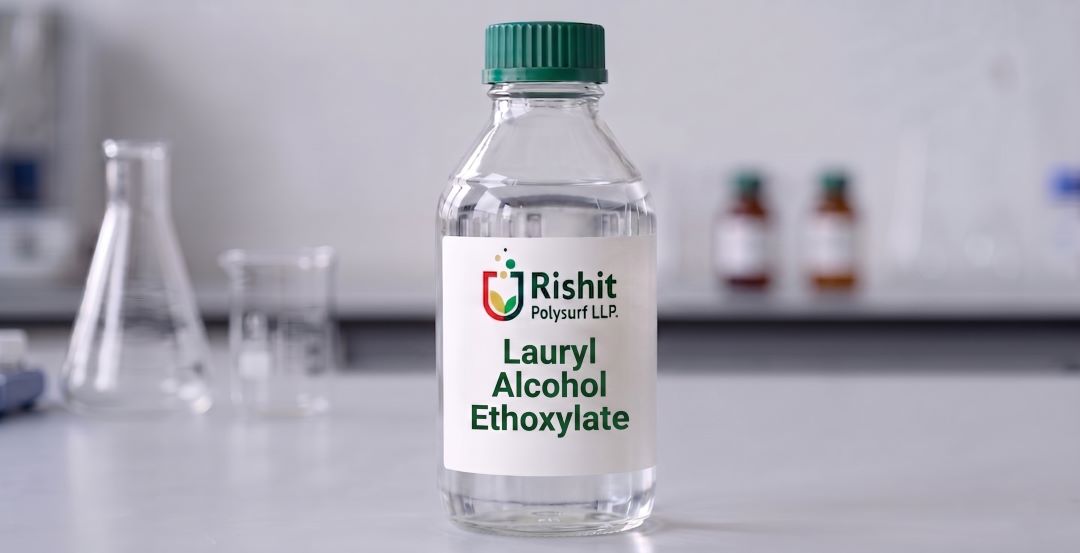
Lauryl alcohol ethoxylates are nonionic surfactants used across detergents, wetting agents, emulsifiers, and industrial cleaning systems.
Product Overview
Lauryl Alcohol Ethoxylate (LAE) is a rapidly biodegradable, high-penetration nonionic surfactant synthesized via the precise ethoxylation of naturally derived C12–C14 fatty alcohols. Engineered to deliver exceptional surface activity without the environmental persistence associated with legacy alkylphenols, the LAE series offers formulators a highly tunable Hydrophilic-Lipophilic Balance (HLB) profile. As a primary structural precursor and standalone emulsifier, these fatty alcohol ethoxylates provide process-critical wetting, superior foaming, and rapid lipid solubilization across both extreme alkaline and acidic environments
Quick selection guide
- Lower HLB grades: Engineered for water-in-oil (W/O) emulsification and stable dispersion in oil-rich systems.
- Mid-range grades: Optimized for rapid surface wetting, co-emulsification, and balanced phase stability.
- Higher HLB grades: Designed for maximum aqueous solubility, heavy-duty detergency, and oil-in-water (O/W) solubilization.
Technical Specifications
Values below are transcribed from the attached lauryl alcohol ethoxylate specification sheet. Use the horizontal scroll on smaller screens to view the full table.
| Product | HLB | Appearance | Moisture % | pH (1% aq.) | Hydroxyl Value | Cloud Point 10% in 25% BDG | Cloud Point 1% aq. | Cloud Point 1% in 10% NaCl | Colour (APHA) | Free Alcohol | PEG% | Surface Tension (mN/m, 0.1%) | Free EO (ppm) |
|---|---|---|---|---|---|---|---|---|---|---|---|---|---|
| LA-1 | 3.66 | Clear liquid @ 30 C | 0.2 | 6.0-7.5 (3%) | 230-245 | - | - | - | 50 | 52 Max | 1 Max | - | 10 Max |
| LA-1.8 | 5.8 | Clear liquid @ 30 C | 0.2 | 6.0-7.5 (10%) | 200-215 | - | - | - | 50 | 30 Max | 1 Max | - | 10 Max |
| LA-2 | 6.2 | Clear liquid @ 30 C | 0.2 | 6.5-7.5 (10%) | 195-205 | - | - | - | 50 | 25 Max | 1 Max | - | 10 Max |
| LA-2.2 | 6.6 | Clear liquid @ 30 C | 0.15 | 6.0-7.0 (3%) | 188-192 | - | - | - | 50 | - | 1 Max | - | 10 Max |
| LA-2.5 | 7.2 | Clear liquid @ 30 C | 0.15 | 6.0-7.0 (5%) | 184-188 | - | - | - | 50 | - | 1.5 Max | - | 10 Max |
| LA-2.75 | 7.63 | Clear liquid @ 35 C | 0.15 | 6.0-7.5 (1%) | 173-180 | - | - | - | 50 | - | - | - | - |
| LA-3.0 | 8.05 | Clear liquid @ 30 C | 0.2 | 7.0-8.5 (1%) | 167-173 | 60-62 | - | - | 50 | 20 Max | 1.5 Max | - | - |
| LA-4.0 | 9.5 | Clear liquid @ 25 C | 0.2 | 5.0-7.0 (5%) | 145-155 | 65-69 | - | - | 50 | - | 1.5 Max | - | - |
| LA-5.0 | 10.6 | Clear to turbid liquid @ 25 C | 0.5 | 7.0-8.0 (10%) | 126-136 | 70-74 | - | - | 50 | - | - | - | - |
| LA-6.0 | 11.5 | Clear liquid @ 35 C | 0.5 | 6.0-7.5 (3%) | 118-124 | 41-45 | - | - | 50 | - | - | 27.8 | - |
| LA-7.0 | 12.2 | Clear liquid @ 35 C | 0.5 | 7.0-8.5 (3%) | 106-116 | 50-56 | - | - | 50 | - | - | 30 | - |
| LA-8.5 | 13.1 | Liquid/paste @ 35 C | 0.5 | 6.0-8.0 (3%) | 92-105 | 62-74 | - | - | 50 | - | - | - | - |
| LA-9 | 13.4 | Solid @ 25 C | 0.3 | 6.0-7.5 (1%) | 92-100 | 72-82 | - | - | 50 | - | - | 30.5 | - |
| LA-10 | 13.8 | Solid @ 25 C | 0.2 | 7.0-8.0 (10%) | 83-93 | 84-88 | - | - | 50 | - | - | 32 | - |
| LA-12 | 14.6 | Solid @ 25 C | 0.15 | 6.5-7.5 (5%) | 73-78 | 80-83 | - | - | 50 | - | - | 35.6 | - |
| LA-23 | 16.75 | Solid @ 25 C | 0.2 | 6.0-8.0 (1% aq.) | 40-50 | 76-80 | - | - | 100 | - | - | 35.7 | - |
| LA-30 | 17.4 | Waxy solid @ 25 C | 0.15 | 6.0-7.0 (5%) | 34.5-37.5 | - | - | 91-95 (1% in 5% NaCl) | 100 | - | - | - | - |
Core Applications
- Personal Care & Cosmetic Synthesis (1–3 EO): Lauryl Alcohol Ethoxylate functions as the foundational intermediate feedstock for synthesizing Sodium Laureth Sulfate (SLES). Its low-EO structural purity ensures a high-yield sulfation process, resulting in exceptionally mild, high-foaming primary surfactants for premium shampoos and body washes.
- Eco-Compliant I&I Detergents (7–9 EO): Lauryl Alcohol Ethoxylate prevents environmental regulatory failures. As a direct, rapidly biodegradable drop-in replacement for Nonylphenol Ethoxylates (NPEs), mid-to-high EO grades deliver superior soil displacement, oil-suspension, and detergency in heavy-duty household and institutional cleaning compounds.
- Textile Wet Processing: Lauryl Alcohol Ethoxylate eliminates uneven chemical saturation. Acting as a high-speed wetting and scouring auxiliary, it rapidly reduces surface tension to strip hydrophobic waxes from natural and synthetic fibers, ensuring uniform dye uptake without generating excessive, unmanageable foam.
- Agrochemical Adjuvants: Lauryl Alcohol Ethoxylate prevents foliar runoff. By reducing the contact angle of spray droplets on waxy leaf cuticles, it acts as an indispensable spreading agent and co-emulsifier in crop protection formulations, perfectly aligning with green-chemistry and Farm-to-Fork agricultural mandates.
Packaging & Supply
Rishit Polysurf LLP offers robust and compliant logistics infrastructure to supply materials globally. Standard packaging options include 50 kgs HDPE carboys, 200 kgs, 210 kgs, 220 kgs, 230 kgs, 235 kgs, 1000 kgs in IBC containers, ISO tanks & Tankers.
Frequently Asked Questions
Lauryl Alcohol Ethoxylate (LAE) is a fatty alcohol-based nonionic surfactant produced by the ethoxylation of naturally derived C12-C14 fatty alcohols, mainly lauryl alcohol and myristyl alcohol, with ethylene oxide under alkaline catalyst conditions.
The number of EO units determines HLB, cloud point, hydroxyl value, and physical state. Rishit Polysurf LLP manufactures LAE across 17 commercial grades, LA-1 through LA-30, from its integrated ethoxylation facility in GIDC Dholka, Ahmedabad, Gujarat.
The feedstock is bio-based and places LAE in the oleochemical surfactant class, which is a commercial and regulatory advantage over petroleum-derived alkylphenol ethoxylates.
Rishit Polysurf LLP supplies 17 grades of Lauryl Alcohol Ethoxylate, from LA-1 through LA-30, spanning 1 to 30 moles of ethylene oxide and an HLB range of 3.66 to 17.4.
Selection depends on target HLB, physical state at process temperature, cloud point relative to operating temperature, and the application function.
Low EO grades suit SLES precursor and W/O systems, mid grades suit wetting and emulsification, mid-to-high grades suit I&I cleaning, and high EO grades suit powders, dispersants, and high-HLB solubilisers.
The preferred grades for SLES production are LA-1, LA-1.8, LA-2, LA-2.2, and LA-2.5. LA-2 is the most widely specified industry standard for Sodium Laureth-2 Sulphate.
Important precursor parameters include free alcohol, PEG%, moisture, and free EO. Lower free alcohol improves mildness by reducing SLS by-product formation, low PEG preserves sulphatable active content, low moisture improves sulphation efficiency, and low free EO is required for personal care compliance.
Yes. Lauryl Alcohol Ethoxylate is the primary technically and regulatorily compliant alternative to Nonylphenol Ethoxylate in I&I cleaning, laundry, and institutional detergent formulations.
NPEs face restrictions under EU detergents and REACH rules, and are listed on ZDHC, Oeko-Tex, and bluesign restricted substance frameworks.
LAE is readily biodegradable, does not form persistent nonylphenol metabolites, and the LA-7 and LA-9 grades are the closest functional replacements for NPE-9 in many cleaning concentrates.
Cloud point is the temperature at which the aqueous solution of a nonionic surfactant turns cloudy and begins to phase-separate. Below the cloud point the surfactant remains dissolved and active; near the cloud point it usually delivers maximum detergency and emulsification.
For the LA series, select a grade with a cloud point about 5-15 C above the process temperature, or slightly higher in electrolyte-rich systems where the cloud point is depressed.
Free alcohol is the percentage of unreacted lauryl alcohol remaining after ethoxylation. It matters because residual alcohol can sulphate to SLS during downstream SLES production, which affects mildness.
In emulsification, higher free alcohol can sometimes add useful hydrophobicity. It is also a fast QC indicator for low-EO grades, where unusually high levels suggest incomplete ethoxylation or contamination.
Yes. Lauryl Alcohol Ethoxylate is used in agrochemical formulations as a wetting agent, spreading adjuvant, and co-emulsifier.
LA-7 and LA-9 are commonly used as spray adjuvants, LA-3.0 to LA-5.0 work well as co-emulsifiers in EC formulations, and higher EO grades such as LA-12 to LA-23 can support solubilisation in water-based concentrates.
Its biodegradability and lack of persistent nonylphenol metabolites make it well aligned with modern agricultural compliance requirements.
PEG% is the polyethylene glycol by-product formed by ethylene oxide homopolymerisation, and free EO is residual unreacted ethylene oxide.
PEG is generally not a regulatory concern in industrial use, but it lowers active sulphatable content in personal care precursor grades.
Free EO is the more critical parameter because it is a carcinogenic residual and must be kept at trace levels, especially for cosmetic raw materials and personal care precursor grades.
Lauryl Alcohol Ethoxylate generally provides faster wetting and lower surface tension than equivalent NPE grades, while also meeting restricted substance requirements that make NPE use in textile supply chains commercially difficult.
LAE is rapidly biodegradable and helps reduce effluent compliance risk.
In practice, it is used as a wetting, scouring, and leveling aid, with foam level managed by selecting the right EO grade or adding a foam suppressant when needed.
In personal care, low-EO grades can serve as SLES precursor feedstocks.
In I&I detergents, mid-to-high EO grades function as biodegradable NPE replacements.
In textile processing, LAE acts as a wetting and scouring auxiliary.
In agrochemical systems, it works as a spreading agent and co-emulsifier that improves droplet coverage and reduces foliar runoff.